
- Italian Prime Minister Meloni says it is time Europe and the Gulf took 'greater responsibility' for 'security and well-being' in the region
- She called for action to ensure 'freedom of navigation without tolls, or indiscriminatory restrictions'
- Leaders at the Europe Gulf Forum echoed her call for action
- Greek Prime Minister Mitsotakis urged a 'strengthening security cooperation, on ensuring the freedom of navigation'
- The meeting heard that the effects of a worsening situation in the Gulf are being felt most strongly in Europe 'with rising cost of living, fuel, energy'
- Meeting took place at margins of UNGA gathering in New York
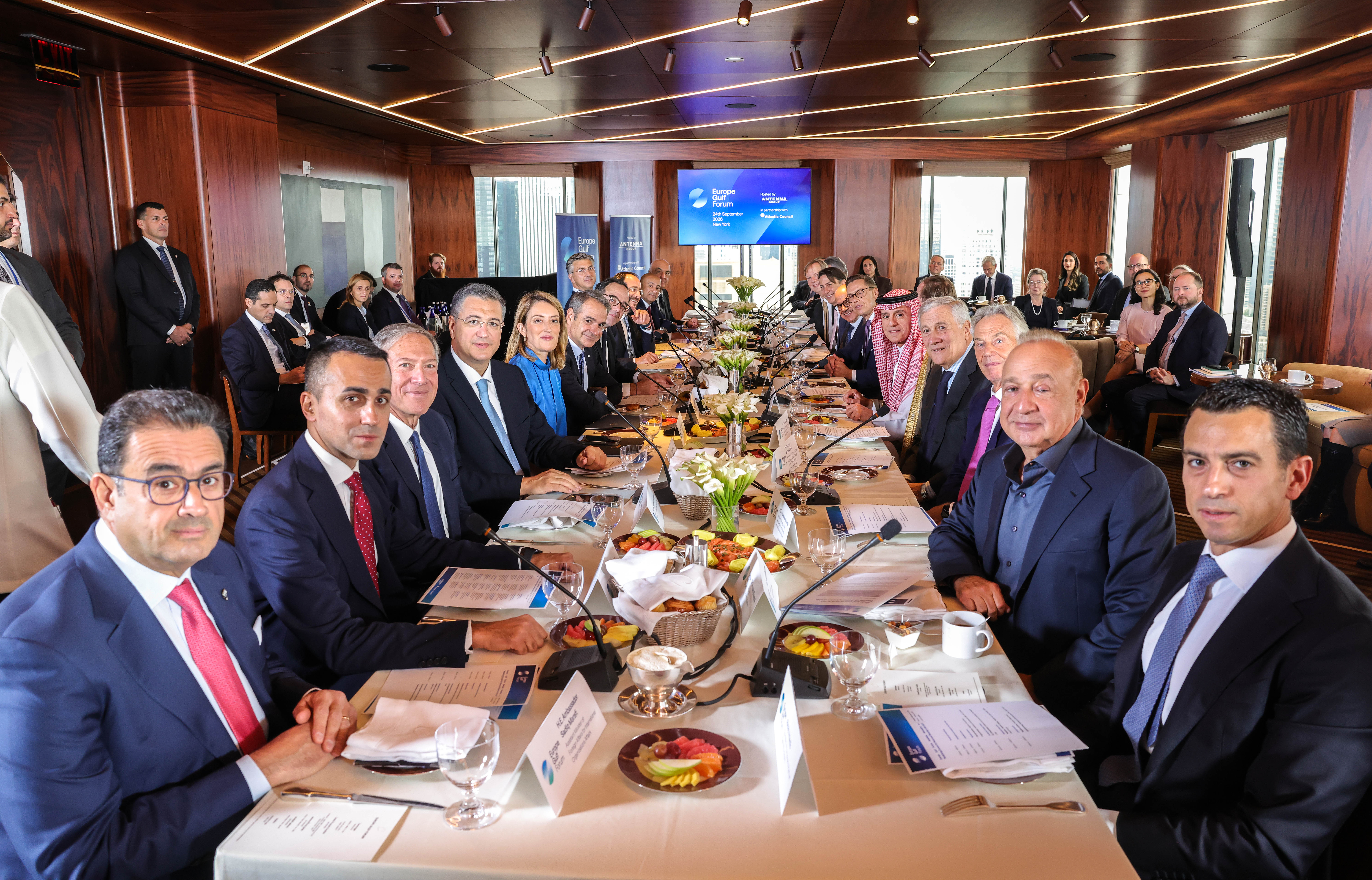
The third meeting of the Europe Gulf Forum (Thursday 24 September) heard leaders from both regions and America urge governments to move faster with more concrete, practical plans or risk prosperity suffering in Europe and beyond. In particular, the on-going issue of trade routes through the Strait of Hormuz was cited as a critical issue.
The meeting of the Forum was convened by Theodore Kyriakou, the founder of the Forum and Chairman of international media company Antenna Group, in partnership with Frederick Kempe, President and CEO of the Atlantic Council. It was also attended by Sir Tony Blair, Mike Pompeo and Amos Hochstein.
Among the leaders from both regions were Prime Ministers of Greece, Qatar, Croatia; Presidents of Cyprus and Finland; Saudi Arabia's Minister of State for Foreign Affairs; representatives of the European Union, business leaders and others.
Italian Prime Minister Giorgia Meloni told the meeting via video: 'Our prosperity depends on lasting peace, open trade, secure connections and shared routes. Starting with freedom of navigation without tolls, or indiscriminatory restrictions. This is why we must work even more closely together.'
She added: 'The time has come to steer our investments towards a shared goal, making it harder to strike at us and more costly to divide us. Connecting our markets, establishing alternative routes, infrastructures and jointly developing technologies and defence capabilities all serve to precisely this purpose. This work must begin immediately.
'I hope this meeting will provide further confirmation that Europe and the Gulf are ready to take greater responsibility for the security, development, and well-being of our peoples.'
Vice President of the Council of Ministers and Minister of Foreign Affairs and International Co-operation of the Republic of Italy Antonio Tajani, added: 'We need more involvement by the other European countries.'
Italy's call for getting the Strait and trade moving safely again was also picked up by others attending the Forum.
Speaking after the meeting attendees talked about the need for renewed urgency and what now has to happen to make a breakthrough in the current crisis.
Prime Minister of Greece Kyriakos Mitsotakis said: 'It is important to focus on strengthening security cooperation, on ensuring the freedom of navigation. We all have an interest in making sure that all international waterways remain open, but also to strengthen economic cooperation through mutual investment.'
Sir Tony Blair, former Prime Minister of the United Kingdom said: 'This Europe Gulf Forum has taken place at a time of acute anxiety for the region. You have the war in Iran. You have got problems with the Strait of Hormuz. You have got problems at Bab al-Mandab. And so for Europe and the Gulf that are connected together, that share strategic interests, that share common worries about what is happening. Europe, particularly with the war in Ukraine, but also because of what is happening in Iran and the Gulf with Iran. It makes perfect sense to come together and to talk about how they might cooperate in order to remove these obstacles and whatever happens in the outcome of the conflict, to make sure we build strength for the future.
'I think there is an immediate priority, which is to ensure that the routes of navigation remain open because this has been a huge problem. The world has never had a situation where you have had essential sea routes - sea routes are the basis of trade - shut down in this way. So one immediate question is how you ensure that the Strait of Hormuz is reopened, that the problems around what the Houthis are doing and attacking Saudi Arabia and the Bab al-Mandab, all of that is managed as best we can.
'But then in the long term, you have got issues around energy defense, obviously, and investment where Europe and the Gulf have a huge amount in common together.'
Mike Pompeo, former Secretary of State to the United States, also focused on the freedom of navigation issue. While noting the progress that has been made by the US and the two regions, he added: 'But there's an awful lot more work to do. And that freedom of navigation and the central ideas of Western civilization matter a lot to both of these regions and that there are many places that we can work together to deliver them.'
Amos Hochstein, Managing Partner, TWG Global, Former Senior Adviser to the President of the US said: 'With the crisis in the Middle East, which is now getting in some degrees worse with the fact that we don't only have the Strait of Hormuz closed, but the Strait of Bab al-Mandab closed, the collaboration cooperation between Europe and the Gulf is more critical than ever.
'The violence may be in the Middle East, but the effects are being felt everywhere, and no more so than in Europe with rising cost of living, fuel, energy, and everything else.'
A meeting of European Union countries and the GCC in Riyadh next month was cited by those attending today's Forum as a critical moment for Europe to show it was offering 'concrete deliverables' on issues like visa agreement, free trade, connectivity and maritime security commitments.
Theodore Kyriakou, Chairman of Antenna Group & Founder & Co-Chair of Europe Gulf Forum, said 'This was a very meaningful discussion, bringing the two regions closer together, to cooperate on security, energy, investments, defense, especially now at a time where it's a critical moment for the Gulf and European leaders.
'It was very encouraging to hear Europe's willingness to support the Gulf even more during this time. And even more importantly, there were actionable solutions discussed that should take place soon.'
Frederick Kempe, President and CEO of the Atlantic Council and Co-Chair of the Europe Gulf Forum, speaking about the establishment of the Forum said: 'We started this Forum before the war in Iran. Now we're seven months into the war. We knew there were great opportunities for investment, technological cooperation, trade, and for tourism. None of that has gone away. But now there's an urgency and the two regions know they have to solve the problem in the Middle East, namely, securing the waterways carrying the lifeblood of the European economy: the oil and the gas that run the European economy.'
Commenting on the quality of Thursday's discussion, he added: 'I've never seen European and Gulf colleagues speak in such practical, positive terms about what they could do together next. These are two regions that have always been neighbors, always been connected, but now understand that they have to do much more to build on their relationships.'
Attendees included:
- H.E. Alexander Stubb, President of the Republic of Finland
- H.E. Nikos Christodoulides, President of the Republic of Cyprus
- H.E. Sheikh Mohammed bin Abdulrahman bin Jassim Al Thani, Prime Minister and Minister of Foreign Affairs of the State of Qatar
- H.E. Kyriakos Mitsotakis, Prime Minister of the Hellenic Republic
- H.E. Andrej Plenković, Prime Minister of the Republic of Croatia
- H.E. Roberta Metsola, President of the European Parliament
- H.E. Antonio Tajani, Vice-President of the Council of Ministers and Minister of Foreign Affairs and International Cooperation of the Republic of Italy
- H.E. Radosław Sikorski, Deputy Prime Minister and Minister of Foreign Affairs of the Republic of Poland
- H.E. Adel bin Ahmed Al-Jubeir, Minister of State for Foreign Affairs of the Kingdom of Saudi Arabia
- H.E. Dr. Abdullatif bin Rashid Al Zayani, Minister of Foreign Affairs of the Kingdom of Bahrain
- H.E. Ambassador Sadiq Marafi, Assistant Foreign Minister for International Organizations Affairs of the State of Kuwait
- H.E. Hamad Rashed Ayed Al-Mari, Assistant Foreign Minister for Gulf Cooperation Council Affairs, State of Kuwait
- H.E. Apostolos Tzitzikostas, European Commissioner for Sustainable Transport and Tourism
- H.E. Jasem Mohamed Albudaiwi, Secretary-General of the Gulf Cooperation Council
- H.E. Luigi Di Maio, EU Special Representative for the Gulf
- The Rt. Hon. Sir Tony Blair, Executive Chairman, Tony Blair Institute for Global Change; Former Prime Minister of the United Kingdom
- Mike Pompeo, Former U.S. Secretary of State
- Amos Hochstein, Managing Partner, TWG Global; Former Senior Advisor to the President of the United States
- Len Blavatnik, Founder Access Industries
- Philippe Amon, Chairman & CEO SICPA
- Michal Solowow, Founder & Owner Synthos
- Alexis Atteslis, Co-Head Europe & Partner Oak Hill Advisors
- Theodore Kyriakou, Chairman of Antenna Group; Founder and Co-Chair of the Europe Gulf Forum
- Frederick Kempe, President and CEO of the Atlantic Council; Co-Chair of the Europe Gulf Forum
For media inquiries, please contact: media@antenna-group.com
